The Short Answer
If your air handler takes a 15x25x1 air filter, buy a 15x25x1. The size is not a manufacturing oddity but the opening your filter rack was framed to, and that rack was built around the equipment cabinet rather than around what a store stocks.
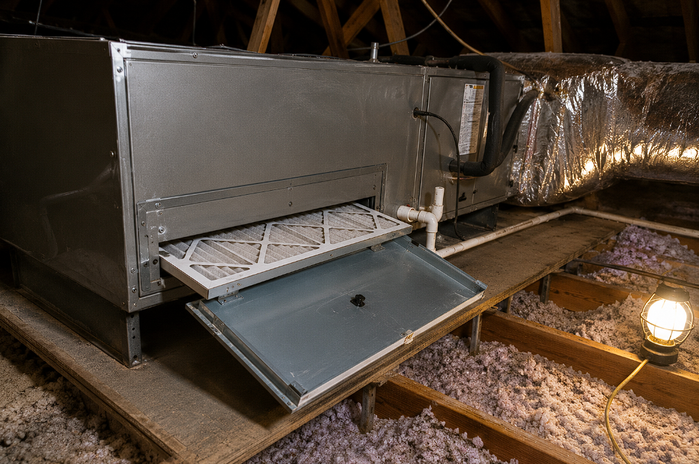
Every 15x25x1 I have pulled came out of the same setup: an older cabinet in a tight space, with a rack fabricated around the return opening in front of it.
Key Takeaways
• Your filter rack sets the size, not your equipment brand. A 15x25x1 fits an opening framed to the cabinet, which is why it turns up on Goodman, Rheem, Trane, and unbadged older units alike.
• Nominal 15x25x1 measures 14.50 by 24.50 by 0.75 inches actual, rounded up on the label so the frame slides in instead of binding.
• A 16x25x1 is not a substitute. The widths differ by a full inch, so it bows in a 15 inch rack or leaves an inch of bypass the other way.
• Never cut the rack to fit a common filter. Have a new one fabricated and sealed instead, which also lowers pressure drop, though it only pays if work is already scheduled.
• Gray, crusted insulation near a return means a filter has been bypassing. It shows there before it shows on the filter.
• MERV 13 is the EPA baseline and most older systems handle it. The bigger risk is a filter left past 60 to 90 days.
Why Older Cabinets Land on Non-Standard Filter Sizes
Your HVAC brand does not set your filter size. Your slot does. Three patterns explain most of the 15x25x1 systems I see.
The rack was built to the return opening. Older racks were fabricated to match the plenum, so whatever fit became the size. A 15 inch dimension turns up wherever a cabinet sits in a tight closet or narrow platform.
The furnace came out of a manufactured or modular home. Those units are built narrower for shallower closets, off the 16 and 20 inch standards.
The system was retrofitted. When equipment was replaced but the plenum and rack were reused, the size stayed with the old cabinet. This one has a tell: if the sheet metal gauge or finish changes where the rack meets the plenum, or the screw pattern does not match, you have original ductwork carrying newer equipment.
None of it depends on the badge on the front, which fits alongside the other myths about standard HVAC sizing. Not sure where your slot is? Start with pinpointing the AC air filter location.
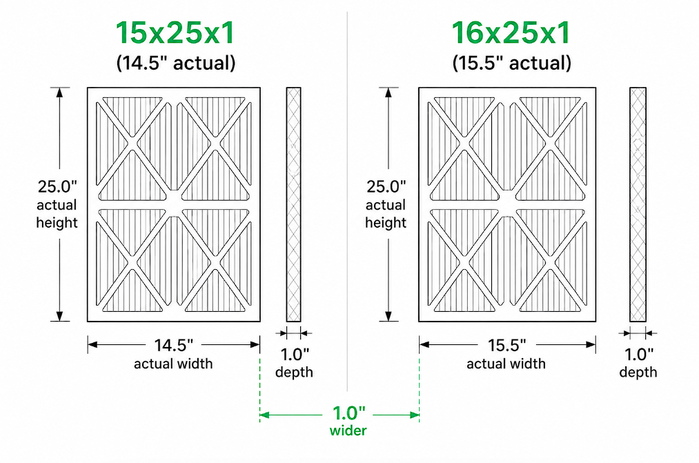
15x25x1 vs. 16x25x1: Why the Inch Matters
You cannot substitute one for the other. A nominal 15x25x1 measures 14.50 by 24.50 and a nominal 16x25x1 measures 15.50 by 24.50, so the length is identical and only the width differs, which is why they look interchangeable on a shelf.
Drop a 16x25x1 into a 15 inch rack and it either refuses to seat or goes in bowed, opening a gap at the corner that sends unfiltered air straight to the evaporator coil. Go the other direction and a 15x25x1 in a 16 inch rack leaves an inch of open bypass, so the filter looks installed while filtering roughly nothing. EPA guidance settles it: a filter should fit snugly enough that air cannot leak around it, and you should never bend or crush one to make it fit.
What the Attic Side Tells You That the Filter Door Does Not
When a filter has been bypassing air for a few seasons, the evidence shows on the insulation rather than the filter. Around a leaking return, the fiberglass or cellulose below the rack turns gray and crusts over on top while the material an inch down stays clean, because the air is being pulled through it like a strainer. That took me a few years to notice, and I read the discoloration now before I open the filter door.
"I can usually tell a rack has been cut or forced before I look at the filter. There is a gray shadow on the insulation right under the return where the leak has been pulling attic air through it for years. The homeowner has been buying the wrong size, and the insulation has been doing the filtering."
So if the insulation near your air handler looks dirtier than the rest of the attic, check the filter size first. Replacing it without fixing the leak resets the clock.
Do Not Cut the Rack. Replace It Instead.
The goal behind cutting a rack is reasonable: you want a filter you can buy anywhere. The method is what fails, on three counts. A widened rack no longer holds the frame square, so you create bypass you cannot see. It breaks the cabinet seal, which matters most on attic equipment where a leaky return pulls in dust, moisture, and unconditioned air. And it saves nothing against what a leaking rack does to a coil. The version I find most often is not even a cut rack but a 16x25x1 wedged into a 15 inch slot with foil tape around the edge, where the tape sits on the frame rather than the leak path.
The alternative that works is a new rack, fabricated to take a common filter, with the plenum transition sealed and the access door gasketed. Any sheet metal shop treats it as routine, and it buys something nobody mentions: a larger face area lowers pressure drop, because the same air volume moves through more media at lower velocity. Since a filter can account for 20 to 50 percent of total system pressure drop, that is a real gain on older equipment.
Whether it pays depends on timing. If you are already replacing equipment or opening the return, the rack is cheap while the sheet metal is apart. As a standalone job to save on filters, it will not repay the labor. So the 15x25x1 remains right for most readers, but if work is already scheduled, ask about the rack. That is not the question that sells more filters.
While you are in there: the slot cover should seal tightly but never be taped shut, since you open it every 60 to 90 days. Air sealing around a mounted air handler is the moment to confirm the size and seal that door, the logic behind coordinating insulation work with HVAC installation.
You Already Have the Wrong Filter in There. Now What?
Pull it now rather than waiting for the change date. What follows depends on what you find.
If a 16x25x1 is bowed into a 15 inch rack, take it out. It is barely filtering while spending pressure the system does not have.
If a 15x25x1 sits loose in a 16 inch rack, you have an inch of open bypass. Order the correct size, and resist the urge to shim it with cardboard or foam.
If either has been running for months, check the coil and blower wheel. Fuzz on the fins or buildup on the blades means the bypass has been depositing where it does most damage, a job for a technician.
And if you need a filter today but cannot get the size, running briefly with none while the correct one ships beats forcing a wrong size that bows anyway. Keep it to days rather than weeks, and skip it if anyone in the house has respiratory trouble.
How to Confirm You Actually Need a 15x25x1
Read the printed size off the old frame first. If it is legible, that is your answer. If not, work the slot itself.
1. Turn the system off at the thermostat, then measure inside the filter track, not the face of a return grille.
2. Round up to the nearest inch. A slot at roughly 14.75 by 24.75 is a 15x25x1.
3. Check depth separately. A 1 inch slot will not take a 2 or 4 inch filter, and forcing depth crushes frames.
4. Check for a second return. Many homes have more than one, and the two are not always the same size.
On attic units I add a step, running a hand along the rack door seam with the blower going. If you feel air at the edge, size is not your only problem.
One ordering trap: manufacturers do not all cut a nominal 15x25x1 to the same actual dimensions, and on a tight rack a quarter inch decides whether the frame seats flat or bows. Check published dimensions rather than the label, and once you find a cut that seats, stay with it.
Choosing a MERV Rating for Your Older Air Handler
Older equipment handles more filtration than most people assume. The EPA recommends at least MERV 13, or as high as your fan and slot allow, and notes most manage it as long as the filter is replaced on schedule. That leaves a real choice: MERV 8 for ordinary dust and pollen, MERV 11 for pets or allergies, MERV 13 for fine particles including smoke. Shop on MERV rather than FPR or MPR, which are retailer scales rather than the ASHRAE method, a distinction that matters if you are comparing filters by FPR.
The blower detail most homeowners never hear. DOE's Building America program documents that a PSC motor stops pushing above roughly 0.5 in. w.c. and simply moves less air, while a variable speed ECM keeps working toward its airflow target and can burn itself out trying. The fragile motor is often the newer one. That reversed my own assumption: the airflow complaints I see come from newer variable speed units on original ductwork, not 25 year old furnaces.
Odd sizes are often stocked in a single MERV tier, which quietly makes the decision for you. The 15x25x1 comes in all three. On attic units I treat 60 days as the number rather than 90, because loading runs faster than in a conditioned closet.
7 Resources That Settle a 15x25x1 Question Before You Order
Confirming an odd filter size raises three follow-up questions: does it actually fit, what can my older system handle, and what if my slot is not a catalog size? These seven answer all three, in the order you will need them.
1. Know Exactly What a Correct Filter Fit Looks Like
Guide to Air Cleaners in the Home (U.S. EPA)
The federal standard for fit: a filter must seat snugly with no air leaking around it, and you should never bend or crush one to make it work. That single rule settles most 15x25x1 versus 16x25x1 arguments before they start.
2. Find Out What Your Older Blower Can Actually Handle
High-MERV Filters (DOE Building America Solution Center)
Explains why most existing filter boxes were sized for a 1 inch fiberglass filter rated around MERV 2, and documents the PSC versus ECM blower behavior that decides how your specific system fails under a restrictive filter.
3. Buy Filtration Instead of Marketing Numbers
What Is a MERV Rating? (U.S. EPA)
The full MERV scale with capture efficiency broken out by particle size, plus the EPA recommendation of MERV 13 or the highest your fan and slot accommodate. Clarifies why MERV is the number to shop on while FPR and MPR are proprietary retailer scales.
4. Get a Second Opinion From a Source That Sells Nothing
Air Cleaning (American Lung Association)
An independent health authority confirming the same fundamentals, with no filter to sell you. Includes a field test I use constantly: hold the filter against white paper to judge whether it is spent.
5. Order the 15x25x1 in the Exact Cut Your Slot Needs
15x25x1 air filters, cut to 14.50 x 24.50 x 0.75
The size itself in MERV 8, 11, and 13, made in the USA. Check the published actual dimensions against your slot measurement before ordering, since nominal labels vary between manufacturers.
6. Solve a Slot That Is Not a Catalog Size at All
For when measuring reveals a true fraction rather than a roundable number. A slot at 14.75 x 24.75 is a 15x25x1, but a slot at 15.25 x 24.50 is custom, and rounding it either direction costs you the seal.
7. See What the Wrong Filter Costs You Every Month
Heat & Cool Efficiently (ENERGY STAR)
Nearly half of home energy use goes to heating and cooling, and a dirty or bypassing filter slows airflow and forces the system to work harder. Sealing and insulating ducts can improve efficiency by as much as 20 percent, with attic runs the first priority.
Supporting Statistics
1. Your Filter Can Eat Half Your Pressure Budget
• Filters account for 20 to 50 percent of total system pressure drop, and most residential systems run efficiently only at or below 0.4 to 0.5 in. w.c.
• A 0.25 in. w.c. filter in a PSC air handler uses half that budget alone.
What it means: margins on older equipment are thin, so a bowed or forced filter spends pressure the system does not have.
Source: U.S. Department of Energy, Building America Solution Center
2. Attic Systems Waste 10 Percent Before Anything Goes Wrong
• Ducts in unconditioned attics raise heating and cooling energy use by about 10 percent, with leakage commonly above 20 percent of conditioned airflow.
What it means: if your air handler sits on an attic platform, you are already paying. Cutting the rack adds a return-side leak that pulls attic air and insulation fiber in.
Source: U.S. Department of Energy, Unvented Conditioned Attics
3. Doing It Right Costs About $12
• Disposable one inch filters run about $12 each, changed roughly every two months.
What it means: modifying a rack trades a permanent compromise for pocket change.
Source: American Lung Association, Air Cleaning
Next Steps
Three things this week, the same three I do on every attic I work in.
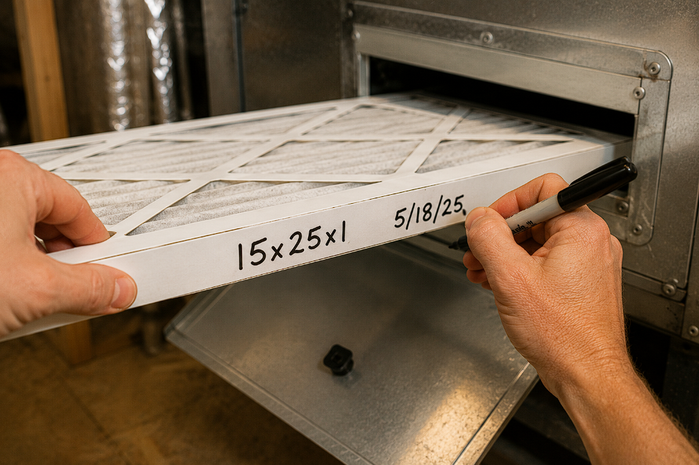
1. Pull the filter and write the size and actual dimensions on the cabinet door in marker.
2. Check the rack door and platform seams for gaps, and look at the insulation near the return.
3. Order the correct size in a multi-pack.
Get the right size: pick the MERV tier your blower can carry, then order the size your slot was built for.
Need help sealing around an attic air handler? Request a free attic assessment.
Frequently Asked Questions
Can I use a 16x25x1 instead of a 15x25x1?
No. The actual widths differ by a full inch, so the larger filter binds or bows in a 15 inch rack, and taping the gap does not solve it.
Which HVAC brands use a 15x25x1 filter?
None exclusively. The rack and return opening set the size, which is why it turns up across manufacturers, mostly in older cabinets and retrofits.
Can I run my system without a filter until the right size arrives?
Briefly, as a stopgap, and it beats forcing a wrong size that bows. Order the same day, and skip it if anyone in the house has respiratory trouble.
My old filter is a size I cannot find anywhere. What now?
Confirm the measurement, then order the nominal size online. Custom sizing exists for genuinely non-catalog openings, but 15x25x1 is not one.
Glossary
Actual Dimensions. The exact physical measurements of an air filter. A nominal 15x25x1 filter in this article measures 14.50 x 24.50 x 0.75 inches.
Air Handler. The indoor HVAC equipment that moves conditioned air through the home. Older air handlers may use filter racks built around the original cabinet or return opening.
Filter Rack. The metal track or housing that holds an HVAC air filter. The rack dimensions determine which filter size fits the system.
MERV. Minimum Efficiency Reporting Value, a standard used to rate how well an air filter captures particles. The article discusses MERV 8, MERV 11, and MERV 13 options for older systems.
Nominal Size. The rounded size printed on an air filter label. A filter labeled 15x25x1 is slightly smaller than those measurements so it can fit inside the filter rack.
Return Opening. The opening where return air enters the HVAC system. In many older installations, the filter rack was fabricated to match this opening rather than a common retail filter size.
Learn more about HVAC Care from one of our HVAC solutions branches…
Filterbuy HVAC Solutions - Miami FL - Air Conditioning Service
1300 S Miami Ave Apt 4806 Miami FL 33130
(305) 306-5027